
The Best of "The Best From Fantasy and Science Fiction, Third Series"
A 1950s Collection Which Rips
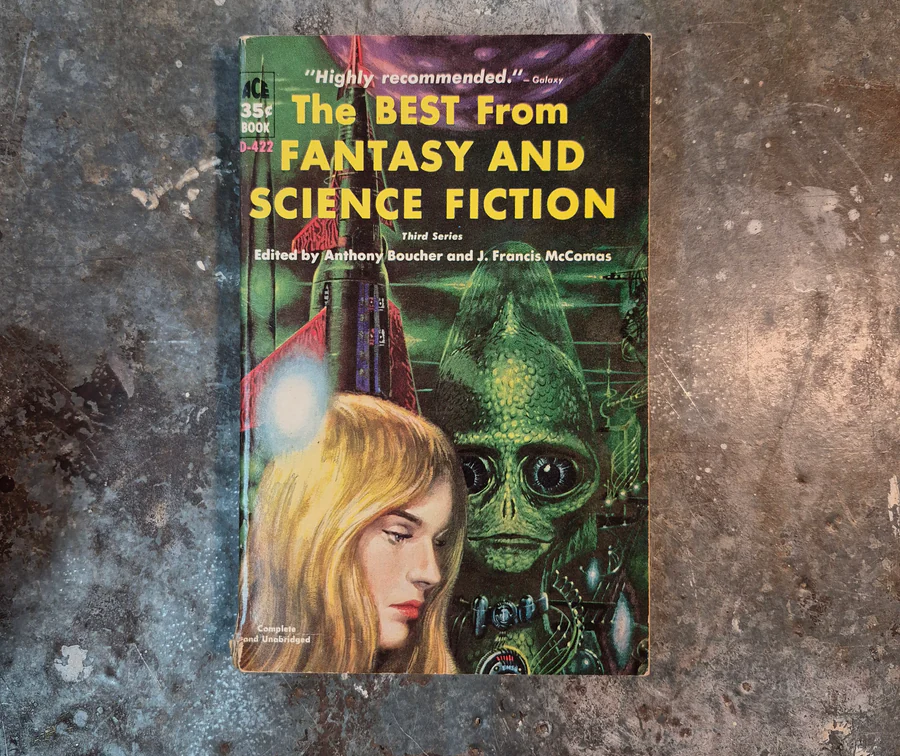
We’ll start with the cover: A beautiful blonde woman staring wistfully past a green scaly alien who has a big green conehead. Behind them looms a rocket ship and a purple glowing planetoid. I believe this image to be derived from one of the tales contained in this anthology, a story about a lizard alien falling tragically in love with a human guitarist. The cover is arrestingly goofy. It grips you with its alien gaze.
The alien gaze demands you open the book. What is the book? It is The Best From Fantasy and Science Fiction, Third Series, edited by Anthony Boucher and J. Francis McComas. A collection originally released in 1954—though the zesty cover indicates my copy is from 1960—Third Series offers sixteen stories bubbling with the dense pulpy weirdness of a pre-New Wave but post-war sensibility. Fifties repression writhes around on the floor until it becomes surprisingly fresh and disturbing.
You may recognize a few names among the authors included in this collection: Philip José Farmer, L. Sprague de Camp, Manly Wade Wellman, and Alfred Bester all contribute. The finest of these is the Wellman. Like much of Wellman’s work, “Vandy, Vandy” concerns the rambling Appalachian adventures of a wise and humble musical magician, who crashes with a friendly family of mountain folk, only to find them under threat from a creepy evil wizard intent on molestation. There’s music, magic, and a wild conclusion before our rambling man sets off for his next adventure. Predating The X-Files or Hellboy, Manly Wade Wellman delivered consistent episodic and evocative Americana thrills and chills. Also, his name rips, literally the most chad moniker of all time. Perfect for the combination Mothman fan/bluegrass stan.
Several of the stories go to places weird and dark enough you could mistake them for the skeeziest contemporary compositions. Ward Moore’s “Lot” is a nasty piece of work, excavating the psychology of a shitty Fifties husband as it crumbles under the pressure of nuclear war. Knowing a tiny bit about the Bible story which furnishes the title only makes the implications of the tale’s conclusion nastier, as I suspect Moore intended. Meanwhile, Charles L. Harness reveals himself as a man who presumably had a fraught relationship with his mother-in-law with the story “Child By Chronos”, a narrative which combines mommy issues and time travel in not quite the way you’re thinking.
Most pleasant and surprising was the fact that three of the sixteen tales in Third Series were credited to female authors, and each ripped. Kay Rogers’ “Experiment” almost certainly furnished the inspiration for the arresting cover image, as it concerns a green lizard alien’s curious and possibly prurient interest in his human female slave. Rogers allows the story to hover in a weird, uncomfortable, oddly sentimental place, as the alien, once convinced of his emotionless perfection, discovers deeper and more tragic chambers in his own space-heart too late. In a heroic show of restraint, Rogers says nothing more, and we are left to wonder if this feeling will change the alien overlord, or simply haunt him as he continues his misdeeds.
“New Ritual” by Idris Seabright slays. Another critique of the miseries and indignities of Fifties married life, Seabright forgoes the hideous cynicism of “Lot” for a perverse and delightful episode of wish fulfilment. Mrs. Marie Bates, trapped on a lonesome farm with her dull and aging husband Henry, discovers her new freezer possesses arcane powers not previously known in temperature-control units. Seabright escalates the story at a steady but relentless pace, as Marie discovers that her husband’s insufficiencies are insurmountable by her wifely efforts alone. She will have to apply the wonders of modern mad science to her Henry problem if she’s ever going to achieve the satisfactions she cannot quite name but very much desires. Long before the coining of the colloquialism “fridging”, Seabright finds a way to make stuffing someone into a fridge a delicious girl power move instead.
Lastly-not-leastly, we come to Ann Warren Griffith’s “Captive Audience”, the most actually-prescient story in Third Series. Astutely observing the horrendous and all-consuming designs of late capitalism, Griffith conjures a world in which every consumer good shrieks out its own advertising to passers-by, filling the air with an ambient mercantile cacophony. Every morning the central family gathers to listen to their cereal announce itself, the cigarette box prompt the father to light up for the day. The mother shambles through her chores as ordered by her soaps and cake mixes. The children live for the Cocomelon-esque delights of their favorite snacks’ fanfares. Griffith predicted the yoke of enshittification under which we all now suffer, and though the means are slightly the different, the essential heart is the same. Her characters no longer have room for thought as their brains fill with the skludgy detritus of what is essentially endless sponcon, personified products selling themselves as the panacea by which to achieve an idyllic mindless lifestyle. And worst of all, they are devoted to their marketing and their masters, seeing those who resist as maladjusted buzzkills who simply need to ingest more ads until they get it. As a person with a dumbphone, I am squarely within the unintended but ideal audience for Griffith’s story. But if you’ve been on YouTube, Instagram, or any ad-supported site recently, you’ll recognize the hideous world Griffith conjures. In fact, we’re lucky that world is mostly trapped inside the internet. She makes it truly inescapable.
The Best From Fantasy and Science Fiction, Third Series is primo mid-century cheesesteak: weird, retro, evergreen, probably bad for your heart. If you can’t find a copy at your local heap-of-used-moldering-paperbacks, then simply peruse the voluminous archives of the magazine available on Archive.org. You’ll tunnel through to all the bangers contained here, and on the way surely find some wacko deep cuts I cannot imagine.