The CRPG After Mass Effect 3, Part I
Towards a New Dichotomy of Role and Playing
In January I promised I would deliver a detailed review of Avowed in the near future. I then proceeded to…not play it again. Instead, I picked up Warhammer 40,000: Rogue Trader to play with a friend of mine.
Owlcat’s games are reliably tedious thanks to their fiddly tabletop-derived combat laden with intricate and sometimes incomprehensible mechanics, as well as their dense, exposition-freighted storylines. I know this because I put 95 hours into Pathfinder: Wrath of the Righteous, didn’t get near finishing the game, and burnt out crazy-style. Rogue Trader is slightly less tedious, but only slightly.
I may never go back to Avowed, so much does it pale in comparison to Rogue Trader. Before playing this game, I’ve never thought a single thought about 40K, while I loved Obsidian’s previous Eora-set games. Am I merely addicted to tedium? Well, I’m a person who’s read War and Peace, so-
But actually I’m not willing to concede that point. In my typical megalomaniacal fashion, I insist my alignment with Owlcat’s latest output over Obsidian’s--when Obsidian was once one of my favorite game companies--indicates something essential about the development of computer role-playing games (CRPGs) over the last fifteen years. Indeed, I would argue there’s a massive hole in our categories and our thinking about CRPGs since we’re still calling Rogue Trader and Avowed broadly the same thing. Certain ludological values have slipped from the frame of AAA CRPG design. Not to sound reactionary, but the disappearance of those values is allowing so-called role-playing games to collapse into long, mildly interactive movies.
There’s a concept from Scott McCloud’s Understanding Comics which has haunted me from the day I first read that book. I see it everywhere. McCloud calls it “closure”, and it’s the work you do between the panels in a comic to make the disparate frames mean something together. He contends that closure’s what produces reader investment in the comic. Interpolating yourself and your interpretation into the work causes you to experience it more deeply. There’s closure in every kind of art to varying degrees. With their gutters and panels, comics make use of it in a very obvious fashion. You’re putting the frames of the comic together in your mind. Other art forms induct you into their reality more subtly.
For me, enjoying a CRPG requires finding a perfect ratio of frustration with the challenges before me, impatience to find out what happens next, and satisfaction at thinking out a workable solution. It’s a process of pleasurable calibration and it is affected by every single aspect of the work from writing to graphics to mechanics to my own finicky hardware. I want just the very right amount of closure, an exactly-foot-wide margin of imaginary space which I walk along as I sample everything the game contains. I want the game to be like an electronic keyboard, providing me a compelling backbeat while I pick and choose the notes of the core melody. That’s the biggest delight of the CRPG mode, to me: the frame of a story, waiting for me to fill it in.
Digital games remain ubiquitous in pop culture and consumer spending. Elements of CRPGs show up across ludic genres. Microsoft snaps up Obsidian and dumps money over their heads to offset all the money they lost on unpopular and beautiful Pillars of Eternity games. But I’m having less fun and everyone I know is unemployed. I don’t feel like picking up Avowed again. I want to stay in the slightly janky, Gordian-Knot game design of Rogue Trader, where character models don’t have facial animations and I’m spending a lot of time reading unvoiced text about mega-dork shit like the “Cicatrix Maledictum” and the “Adeptus Arbites” and on and on and on.
The more money, the more eyes, and the more popularity a CRPG gets, the tighter the possibility space it creates, the less room it provides for the player. The player possesses less narrative agency, does less closure work, and ultimately receives fewer options for outcomes. Meanwhile, cheaply-produced indie games continue to offer richly various narrative opportunities pilled up inside the most grinding parts of tabletop play. The player has to provide closure for much of the experience and they have to lean into the tedium, but in return they get so many more opportunities to design their own characters and stories, which is--in my humble opinion--one of the main reasons to play a game rather than read a book or watch a movie.
Definitions
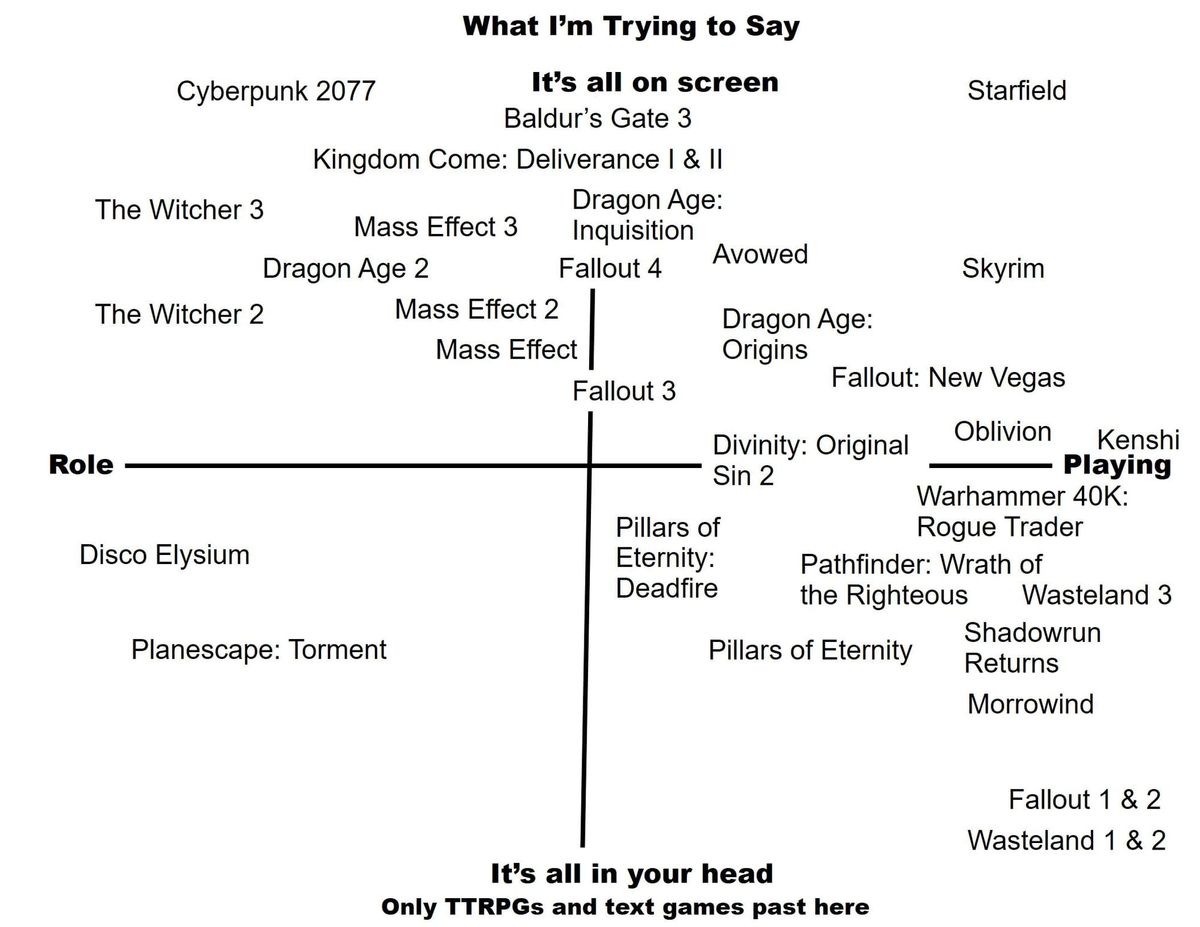
I’ve been struggling with how to pithily express the division I see between these high-budget AAA CRPGs and the cheaper-consequently-more-esoteric ones. I believe the division is best described as an essential tension between the Role and Playing aspects of the CRPG. A Role is a fixed thing, a job or a personality, whereas Playing is an act of freedom which demands the potential redefinition of any fixed factor based on player whim.
One sort of CRPG emphasizes the player’s taking up of a Role offered by the game. Through gameplay the player gets to shade that rather rigid Role in various ways to bring out their personal interpretation. These are the majority of AAA CRPGs, some of them genuinely brilliant. But most are shallow and derivative, trying sweatily to be movies with disgusting runtimes. They’re also unplayably buggéd when they drop. The other, lower-budget sort of CRPG chucks the player into a complex, changeable context and lets them tunnel around to find the numerous outcomes buried in dense systems, changing their mind about who they are potentially a thousand times. These are indie games which are also usually broken on release, but I don’t hear about them until long after they’ve been patched up, so I get two kinds of pleasant surprise from playing them: 1) an actual game with mechanics, and 2) it runs okay.
Let’s define the terms before I get out of control, starting with “role-playing game.” To the degree that any of us have a clean definition or comprehensive understanding of any game genre, we’ll say that a role-playing game is a type of game in which players take up a partially- or wholly-defined subject position within a game world. Usually this is a character. Embedded within that subject position, players then engage in a series of narratively and experientially significant choices over the course of play. These choices are often accompanied by combat or challenges. Frequently character development is measured through the allocation of abstracted values like experience points.
A computer role-playing game is when you do all this with the aid of the computer, instead of your most pedantic friend as the gamemaster.
It’s this definition of CRPG which allows us to call Avowed and Warhammer 40,000: Rogue Trader the same thing, alongside The Witcher, any Elder Scrolls game, Mass Effect, and Kingdom Come: Deliverance. What I must contend is that we are missing a lot of nuance here. However mechanically-indebted Kingdom Come is to Morrowind, they are different on a categorical level, and moreover they got so different because the CRPG form has been in a state of intense mutation since about 2012. I swear I shall tell you why after just a little more preamble.
“A little more preamble” here meaning multiple additional posts.
I shall lay down two other boundaries for this discussion. I will not be addressing text-centric games--that is to say, visual novels, interactive fiction, or games with little to no graphical element. I’m interested here in pinning down a trend that is heavily influenced by the cinematic form and affects mostly high- and mid-budget releases. Roadwarden, Citizen Sleeper, all the Choice of Games games: rest easy, for you are not cinematic and happier for it.
I’m also not going to discuss any Japanese RPGs or Souls-type games. The reason is that I don’t play them so I know nothing about them. If you play them and think what I say here is at all relevant to their design, please link me when you drop your own blog post.
Now we can get into it, and by “now” I mean next post. Our CRPGs have split along a line which is made of money. The spend on the game and the number of exceedingly textured cutscenes contained within it govern whether the game will be fundamentally oriented toward 1) acting in a fixed Role or I) Playing in a mutable context. This orientation is expressed most clearly by the type of choices offered by the game. Tune in next time for a second dichotomy to enter the chat.