The CRPG After Mass Effect 3, Part IV
What Makes a Role-Oriented Game?
Halfway through this series and we can safely say I’ve spent a lot of time pontificating on ideas which are probably either wholly self-evident or completely incoherent. Thus I’ve decided to provide examples which allow me to deploy some of this theory about Role-orientation and Playing-orientation, effective and expressive choices, etc. We’ll start by confronting the Role-oriented game in its most exemplary and dismal forms.
Exemplars & Failures of Role-Oriented Games
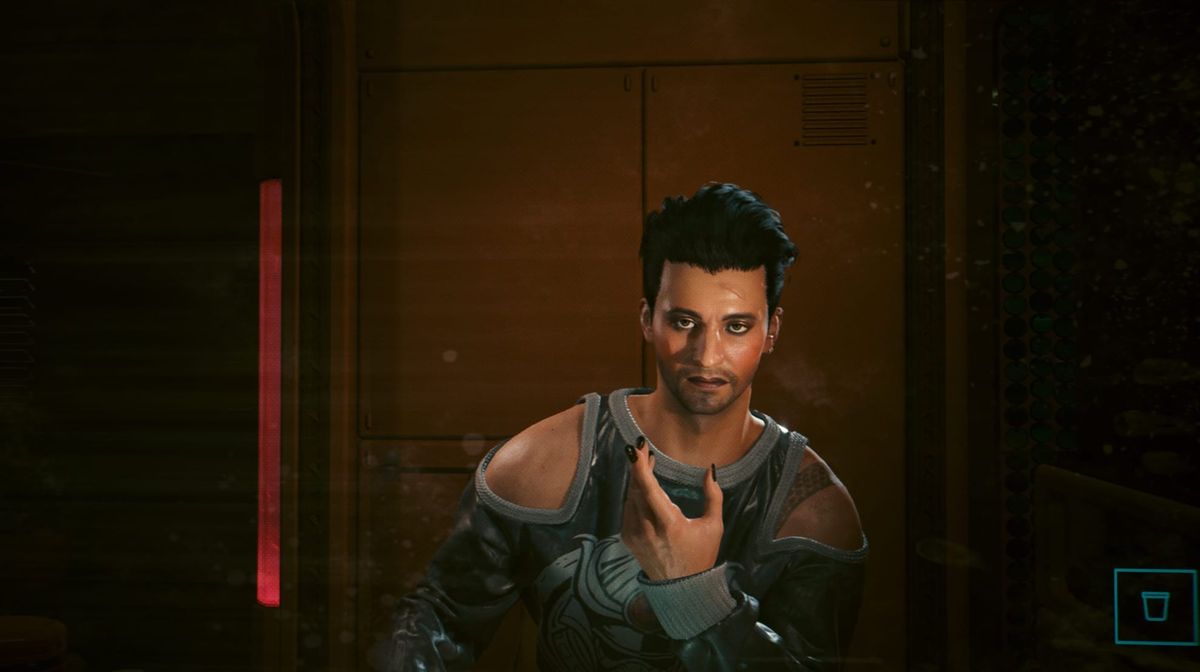
I have discussed my sick relationship with Cyberpunk 2077 in other essays and in other media. While everyone else nursed their legitimate grudges with a disastrous release, I the wise consumer who no longer preorders revelled in 2077’s aesthetic beauty and functionality five years after its actual release. This game gave me a few juicy effective choices (and also an expressive choice regarding how large my dick should be). Mostly it offered me the stage role of a lifetime as tragic hero V. I went into full Shakespearean actor mode. I passionately walked my character around the cutscenes, cast my gaze in meaningful directions, pretended to emote even though it was a first-person game and I basically didn’t have a face. I became a terminally ill twenty-something twunk in love with an elderly rock star. I have been changed by the experience of being said twunk.
The narrative genius of Cyberpunk 2077 comes in the decision to give you a clear, telegraphed choice of several endings and to squeeze them for all the expressive satisfactions possible. No matter how you play the game, in the end you’ll choose how to deal with the haunting specter of Arasaka Tower, an edifice metonymic of your brain’s imminent liquification. This choice affects where you spend your epilogue and who’s with you. These endings are only lightly dependent on the effort you expended in playing the game, and as accounts of outcomes they are not particularly comprehensive, but each provides a contrasting grace note to your story.
I was entirely satisfied with my ending. I don’t ever feel the need to play Cyberpunk 2077 again because the final statement I produced was so definitive. Though this was really only one effective choice, maybe two, I leveraged it into an emotionally affecting experience, expressing ideas which mean a lot to me. V lived his life in the shadow of glory and in my telling he gave everything up for that glory because he couldn’t bear to merely fade away.
Also, my V was gay and in a sublitorally homophobic way Cyberpunk 2077 makes it impossible to maintain your mlm relationship while pursuing the most normatively “happy” ending, which left me to make my peace with the bittersweet ending instead. This points, in a sidewise fashion, to a persistent flaw of Role-oriented games we’ll discuss several paragraphs in the future.
Anyway, the thematic density of the ending choice is why I consider Cyberpunk 2077 an exemplar among Role-oriented CRPGs. From a role-playing angle, V’s nature is quite constricted: you have exactly three options for backstory, some limited combat variations (short gun/long gun/sword/evil arms/computer), and no opportunity to roleplay a V who’s not culturally white in every way. But if you are, like me, interested in painting by CDProjekt Red’s numbers to see what picture comes out, you can count on a soul-rending depiction of life’s unwinnable war against death, one which will stick with you because you do get to choose what it all means in the end. Other gamers may find their most rewarding Role somewhere else, and quite legitimately so, but my V, cringefully, was for several years the home screen image for my phone. “Do it for him”, I whispered to myself while I checked my emails.
I thought long and hard about what failed Role game to draw up against Cyberpunk 2077. But when I examined the four-quadrant chart I made for this essay series, I realized I couldn’t wholeheartedly condemn any games I’d put in that square. I’m even one of those sick Dragon Age 2 apologists. I could put Mass Effect: Andromeda in here, I suppose, but that would be flogging a horse who’s been dead for decades and didn’t deserve capital punishment in the first place. In truth, I don’t think there are that many bad Role-oriented games, not in the AAA and AA space I’m considering here. By their nature, they’re narratively much safer, following all the same storytelling rules from movies and TV while sprinkling in some branching and some battles. Boom: the cat is saved, though whether by helicopter or tractor beam is up to you.
If there is a core ludic complaint I could level against the Role-oriented games, it would be their roteness, which is a type of boredom distinct from the tedium I ascribed to Warhammer 40,000: Rogue Trader way back in Part I. Roteness is a state of surpriselessness, a pervasive familiarity of mechanics, characters, and storytelling. Roteness clings to all of these games in almost exact proportion to the length of their respective TVTropes pages. My god, man, don’t you realize Mass Effect 1 and Dragon Age: Origins are nearly identical in structure? Fabula aside, there’s no variation—a prologue, three or four core missions the player orders, and a climax. And this structure changes little from Bioware game to Bioware game, their success leeching out into the water of the whole genre. The same follower archetypes recur and recur, getting simpler and simpler as mechanics are subtracted away to draw in the Fortnite set. It’s all familiar. I get older and it keeps getting familiar-er.
And then of course there’s the lack of game. When you see me at the TTRPG table, you will find me habitually running rules-light games and complaining about overly intricate and crunchy systems. This is because of my challenges with arithmetic (though I’ve been practicing) and my preference for prioritizing player contributions and creativity over rules systems when gaming with other people IRL. But the computer exists to do math on my behalf, as is its purpose, so I welcome overcomplicated and intensely entwined systems in that venue. I like leveling characters and optimizing their stats. I like applying mental effort in order to achieve success. Most Role-oriented games have thin mechanics: gun-shooting and dialogue-clicking. Walking around and whatnot. I didn’t engage with V in Cyberpunk 2077 in a mechanical fashion. When he locked in with his boyfriend, he got a cool-looking gun, so I almost always used that. I lacked incentive to think about the issue any further. By the last third of the game, I was so bored of fighting. I’d solved fighting, and raising the difficulty level was not going to make it more interesting, merely more sloggy. This feeling arises at some point in nearly every Role-oriented game I play. It’s not burnout, it’s…boredom.
At least uncreative writing and design choices could be fixed. A more intractable problem I observe in Role-oriented games is the one to which I alluded above with the impossibility of reconciling happiness with my V’s sexuality: specific defaultness. A Role-oriented CRPG wants you to be someone specific, even if you can customize that specific someone’s gender, sexuality, and skin color. Whoever that specific someone is, they’re usually written and developed by a millennial white guy, and his words will always sit in your character’s mouth no matter how different from him you’ve crafted your character to be.
Cyberpunk 2077 shudders under the weight of its default whiteness by nature of being a game set in a major, though imaginary, US city which is meant to be as diverse as real world US cities. Most of the gangs you encounter are somewhat ethnically derived, and you never have the opportunity to evince prior familiarity or connection with their culture. Your best pal is Jackie, who’s Latino in a way implicitly contrasted with V’s absent culture. You’re always portrayed as apart from the ethnic conflicts visible in Night City. No matter what skin color V has, they are eternally unsignified in their culture and background. But there’s no actual unsignified person. In Western media, the absence of ethnic signifiers is nearly always whiteness. Everyone on The Simpsons is yellow, except the characters who aren’t white. V is very much Simpsons yellow.
Same with any other identity category. My friend who played Cyberpunk 2077 experienced significant and valid discomfort at the scene where Johnny Silverhand beats up on V. Unlike me, my friend chose to play as female and wouldn’t you know it, a man bashing a woman’s face into a window doesn’t play like bro time. The game may let you choose the voice of a female performer or a body with breasts and a vulva or whatever options mean being female to you, but it does not accommodate that choice or the feelings that choice provokes in you. No matter what features V has, they’re a person who gets beat up by Johnny Silverhand and probably ends up bros with him. The expressive nature of these gendered choices affects the player’s experience, without allowing them to affect their outcomes. Knowing this, having talked to to my friend about her experiences playing the game before I picked it up, I willfully chose to play as a white male character, conforming to the game’s expectations. And still in the end my intentions and the game’s could not quite align, thanks to my lack of interest in hot motor babes.
The nature of the Role-oriented game is such that the game supplies 2/3rds or more of the meaning inherent to your character, and where that meaning clashes with the meaning you’re bringing, the game’s meaning will win out. And due to various factors, including the limited diversity of game writers’ rooms, the game’s meaning rarely reflects marginalized viewpoints or outsider perspectives. I don’t have a prescription for how to solve this problem in your Role-oriented game. I’m not the right person to ask. In this case I must play the perennial critic’s role and point out a problem while offering no help in fixing it.
As we now shift gears to talk about exemplar and awful Play-oriented games, don’t think I’m trying to claim games like Warhammer 40,000: Rogue Trader or Pillars of Eternity are triumphs of representation. Every CRPG has its cringe-inducing oversights. But the lower production values of games like Rogue Trader and Pillars comes with a commensurate reduction in game-imposed meanings. Since I’m imagining how my character’s conducting themself in every scene and I’m the one reasoning out why they’ve making the choices they do, it’s easy enough to interpolate my own contexts into the game. I can Play with the meaning of scenes and encounters more freely than I do as V, who brings a lingering white-straight-masculine context to all their exquisitely rendered encounters, no matter the voice, body, or skin tone I might apply to them.