The CRPG After Mass Effect 3, Part V
What Makes a Playing-Oriented Game?
Last time we discussed Cyberpunk 2077 and how Role-oriented games are easier to make good, but harder to make interesting. Much like big-budget Hollywood movies, Role-oriented RPGs seem incapable of surprising me and in typical megalomaniacal fashion it’s all about me.
Playing-oriented RPGs surprise me perpetually, but sometimes it’s with their exquisite impenetrability.
Exemplars & Failures of Playing-Oriented Games
Have you ever played Kenshi? What a beautiful, terrible game Kenshi is, like if someone smoked uncut Morrowind while playing The Sims. Kenshi is the moooost open-world role-playing game. The Role occupied by the user is that of invisible motive force driving the frantic survival actions of a constantly shifting group of nomads immersed in a deadly alien weeb world. I have never gotten more than a couple skill levels deep into Kenshi, but I am never less than in love with it. You are exclusively Playing in Kenshi. The only way to know if an event or an occurrence is important is if you deem it to be so.
Or if your entire party gets killed by it.
A more traditional exemplar is my beloved Pillars of Eternity 2: Deadfire. Deadfire does everything and then some: you’re a prophet, you’re a psychic, you’re a pirate, you’re friends with Matt Mercer twice. You do a million fiddly little battles with your numerous little buddies and talk to a million people about their socially-constructed subject position within the exceedingly detailed but only ever isometric world. You make a few reality-altering decisions about a certain giant green god and many life-altering decisions about everything else. What you’re waiting for most urgently is the slideshow after, when you learn how your decisions accreted upon each other to create a situation even weirder than the one you found when you got there. You’re crafting outcomes and making decisions and sometimes getting utterly trashed by your enemies.
If I recall correctly, Deadfire was a commercial failure. I’m not sad about this, because it came out, I played it, it was wonderful, but I understand why this fact would weigh upon the folks at Obsidian, who need to keep shelling out health insurance premiums for their employees. I can see why it would require you to allow yourself to bought out by Microsoft. However, I miss the possibility space produced by the isometric Pillars games. I felt myself transported to this other world and enclosed in its vibrancy. There was something vital about the amount of me which went into it, and the commensurate amount of it which went into me. Maybe it was the potency I felt in being able to decide so completely what was important to me about the game: being a pirate, being an imperialist or an anarchist, being a problem for everyone who met me. Maybe it was mediating among my disagreeable followers and their irreconcilable political agendas. Maybe it was when they did go through with their threats to dump me after I rejected their convictions.
I made choices and Eothas help me I experienced the consequences! What Kenshi and Deadfire have in common is that they are machines for putting guys into scenarios, scenarios which you the player must resolve. In Kenshi, said guys are ill-defined except as you like to define them; they may be cogs in your grand design, or they may have endless backstory you’ve crafted for them. Deadfire gives you a set of professionally-crafted guys and professionally-arranged scenarios, but lets you drive the boat (literally).
A Playing-oriented game can easily turn tedious or incomprehensible. Erecting a million disparate funny scenarios for you to resolve requires miles of worldbuilding or throngs of other actors or layers of interlacing mechanics, or ideally all of the above. If you tried to make a Playing-oriented game without any of these, you’d make the most boring, rizz-less CRPG ever known to man.
Speaking of which.
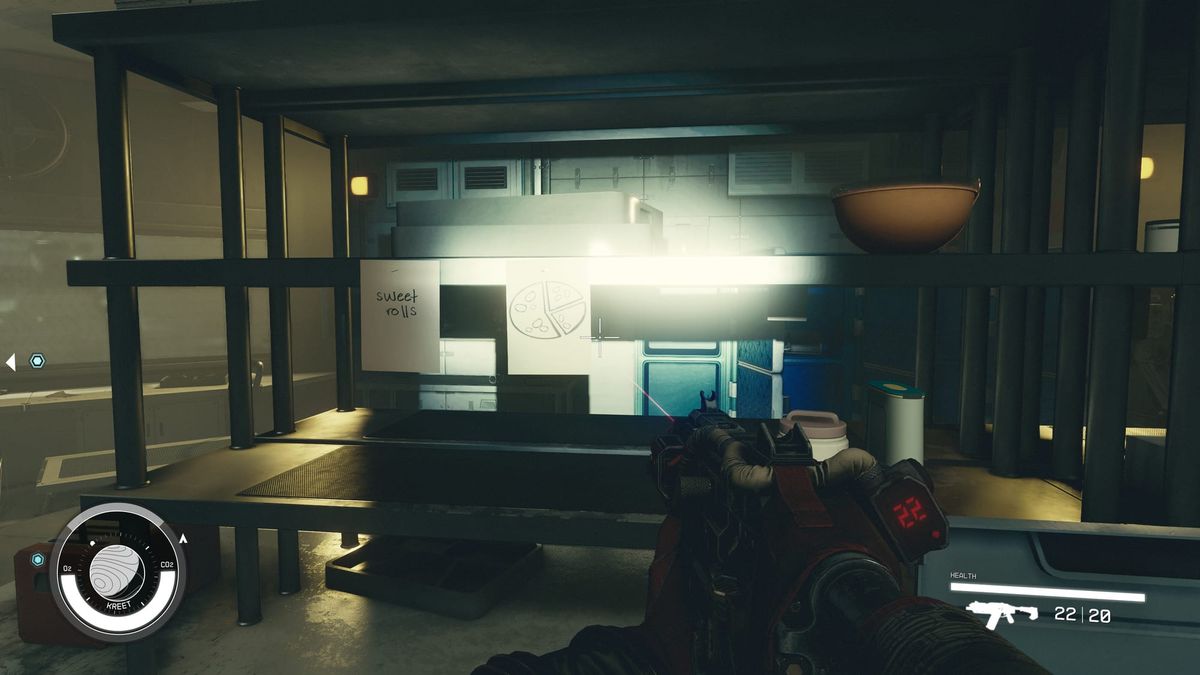
When Bethesda Softworks hyped up Starfield, they pitched it as “The Space Game”: the game to let you do every space-type thing you’d ever wanted. You would captain a customizable spaceship with various space-type followers, visit a bounty of crunchy planets full of alien critters, shoot your space gun the whole time. It did, upon release, contain all these things. Yet when Starfield arrived on gamers’ PCs, they found it lacking, and for once not unreasonably. Bethesda managed to create a game where you could theoretically go anywhere and do anything, but not in an interesting way. They made their Playing-oriented game not only tedious, but dull.
Previous Bethesda games had been tedious in the mode of the Playing-oriented game. I identify as a Morrowind girlie of the highest order, but I will never claim Elder Scrolls games aren’t tedious. When you’re level one and swinging your sword ten times to hit once, you’re living tedium. When you’re grinding through the incomprehensible Oblivion persuasion mechanic to lower a merchant’s prices to save imaginary money, you’re living tedium. When you’re being a stealth archer--your fourth consecutive character who’s turned out a stealth archer--in Skyrim, you’re living tedium. But the chaotic nature of Elder Scrolls games keeps you going. You might be a stealth archer yet again, but this time when you shoot your arrow you miss the bandit and hit a city guard, aggroing all of Riften and stumbling into a hilarious massacre which cranks your bounty sky-high. Now you’ll have a different outcome than last playthrough. It’s not dull, because you’re still making the effective choices for which you come to these games. You might not be able to express much, but you affect the game world with every click of your mouse.
They forgot to put any choices worth making into Starfield, expressive or effective. You can make your character look however you want and you can branch a bit in dialogue, but you can’t lean into any particular sort of character. There aren’t adequate foundations in the game to build a schtick on, even if you keep the schtick 90% in your mind. And there are no effective choices to be made: you can’t even kill NPCs by accident. Most of them are marked essential. The vast majority of the game, as I experienced it, was composed of bland planets full of bland creatures. They weren’t worth killing and they weren’t worth talking to either. They just were. Somehow the designers had left no gap into which I could put any of myself and provided no compelling narrative to which I could subordinate myself.
Kenshi is as open a plane as Starfield, offering no direct goals or purposes, but it constantly knocks on your door with new narrative opportunities. Most of these opportunities are opportunities to be killed by bandits, but they are narrative opportunities nonetheless. The game slaps you constantly with the basest meaning of existence: survive, survive, survive. Starfield lay there inert, unmoving and unreactive, like me when I’ve decided the relationship is over but not told you yet.
Starfield is the most unsuccessful Playing-oriented game of my lifetime, design-wise.
The good news is that surely the general shellackation of Starfield means we won’t be subjected to a Starfield-derived franchise any time soon. The bad news is I still must address the other major CRPG franchises before I’m done with this mad screed. Tune in again soon to study the Role/Playing dichotomy as expressed in the Western game industry’s biggest roleplaying franchises.
But first: a set of short books reviews, and then my highly-anticipated report on Adult Quizbowl.