The CRPG After Mass Effect 3, Part III
The Incident
We spent Parts I and II of this deranged manifesto with my sketch of Role-oriented games and Playing-oriented games, supported by my classification of CRPG choices as either expressive or effective. At the end of Part II I posited that the increasing divide we’ve seen develop between Role-oriented and Playing-oriented CRPGs took root in the wake of the legendary internet disaster of Mass Effect 3’s ending.
Prior to Mass Effect 3’s release--if I may conjecture about years when I myself was like ten years old--we’d been living in a somewhat halcyon state of exponential CRPG-improvement. People’s at-home hardware got better and better, allowing games to have prettier graphics, bigger game worlds, extensive voice-acting, and sometimes even simulated physics. “Digital game designer” got more like a real job and less like a thing you did only if you were a TTRPG weirdo who happened to be friends with the one guy on your block who owned a PC.
We could now afford to make lengthy full-3D video games with hot characters who talked all the time and could even act in cutscenes that looked halfway decent. Bioware, the studio behind the Mass Effect franchise, did so multiple times. But when they reached Mass Effect’s third installment, the developers found themselves painted into a very tight corner. How do you answer for every single choice a player deems important over the course of a 60+ hour game, not to mention 120+ hours of previous games, without dragging a bazillion voice actors back into the booth and designing potentially hundreds of contingency cutscenes and interactions, knowing everyone is expecting you to tie all this crap up into a vaguely sensical denouement?
Chaos and Despair
We know the punchline: you don’t. You can’t. In hindsight, ending Mass Effect 3 in a way that pleased everyone was impossible. And in the creative team’s defense, they made a heroic effort to squeeze numerous series-spanning callbacks into ME3’s storyline.
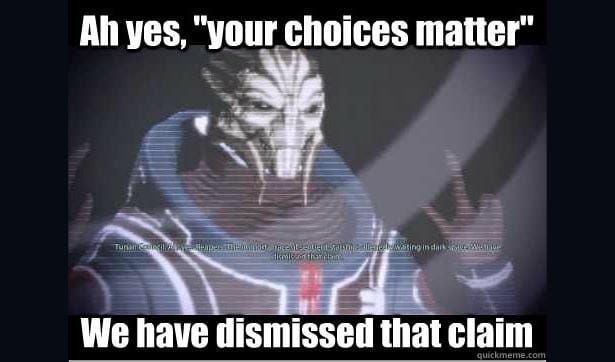
However, much of the game feels like a response to what the devs guessed would be the most popular prior choices. Unfortunately, the nature of people means that very few players made all the most frequent choices, leaving something to piss off everyone. To construct a neat movie-like climax, every branch of every decision tree was trimmed down to the simplest possible acknowledgement of its outcome in an arborological killing spree which slashed away the payoff to all kinds of choices, especially the less popular Renegade ones. Players waited for four or five years to find out the punchline to these choices, only to learn there was no punchline. I suspect players already felt some dissatisfaction with ME3 before discovering the game’s enormously underwhelming ending choice. I was a pretty normie Paragon player less than sixteen years old in 2012 and I remember moments of confusion and cringe at the narrative foreclosures of Mass Effect 3’s main storyline, though perhaps those moments shine much brighter looking back.
Everyone’s been angry about the ending of Mass Effect 3 for so long that I will never need to talk about it at length, but I’d like to highlight a few of its failings as re-examined via the terms I invented last post. A significant mistake of Mass Effect 3 was its betrayal of a key Playing promise well-fulfilled by its widely-beloved predecessor. In Mass Effect 2, if you worked hard and chased down every lead in the game; sucked up to every one of your, like, twelve followers and held their hands while they confronted their abusive dads (all twelve of them, I’m serious!); and spent time considering their strengths and weaknesses--stats-wise and personality-wise--before assigning them jobs, you got a better outcome at the end of the game. The more you engaged with the world and its content, the more heroically you could conclude your story. Once you knew this, it made everything you did in Mass Effect 2 feel high stakes and satisfying, and it took you into Mass Effect 3 with an implicit promise: same game, same idea, but double or nothing, whole galaxy at stake. Do everything you can find to do in this game and you will secure the outcomes you want. Play hard.
Mass Effect 3 even gave you a stat by which to measure your progress: War Assets. This was also where the writers incorporated much of the follow-up to your choices from prior installments. Spent time doing a grindy sidequest way back in ME1? Get another ten War Assets and a funny email from the character who gave you that quest.
Yet the War Assets only ever unlocked the trio of different-colored endings, all of which implied a major galactic meltdown one way or the other. Just now I had to look up whether the War Assets did anything at all, so little did they impress themselves upon my memory of playing this game. The writers and designers integrated the War Assets and the endings in exactly the wrong way because they missed exactly what the players cared about: Playing to ensure their favorite characters lived happily ever after. I admit this is not an artistically lofty aspiration for players and won’t teach them much, but, like, it’s a video game about being a pew-pew space marine fighting robo-squids. It’s for passing time and feeling good.
Mass Effect 3’s creative team zeroed in myopically on the Role they wanted to create for Commander Shepard: Christ-like galactic savior complete with death, resurrection, and death again. This is a storyline which has worked in a million movies and TV shows, sure, but those media don’t function the same way as role-playing games. Viewers of shows don’t built an intense projection connection to the central character the way many gamers do. Gamers have a (yes, at times extremely dangerous and troubling) sense of entitlement to their main character’s status and story. When their control over Commander Shepard’s destiny was taken away, the players lost their agency over the game’s narrative, undermining the whole function of the game as a game.
The game’s writers failed to consider how far and wide players had stretched the Role of Commander Shepard in the first two games by Playing with combat strategies and character classes, favorite NPCs and love interests, and everything else they could find. When the writers and designers of ME3 snapped Shepard’s Role back into place as the galactic martyr they imagined, they created a terrible backwards domino effect where players realized that potentially hundreds of choices they’d made over the trilogy were expressive, not effective, all along. Moments players had invested with massive significance to their personal storylines turned out to have no significance at all.
I’m sympathetic to the team behind Mass Effect 3. The teams on Mass Effect 1 and 2 wrote many blank checks to players, and the folks who worked on ME3 tried to pay out the majority of them. It’s no surprise they went narratively bankrupt by the end.
The internet outrage after the end of ME3 was level red. Gosh, was it a newscycle and a half in the video game world. Bioware and Electronic Arts lost a whole hell of a lot of face, so badly that they released a free DLC adding an ending slideshow to explain what happens to every beloved character after Commander Shepard selects the red, blue, or green slurpee. The slideshow soothed some of the players’ seething over the conclusion, as it answered their desire to see the outcomes of their choices.
While gamers did behave like piss babies upon their disappointment with ME3, they weren’t wrong to be disappointed. It is okay to be unhappy with a failed creation; it’s just literally never okay to send death threats to people for any reason. I managed to be sad about the game’s ending and not harass anyone online, but then I am female, my relationship with my dad is relatively unfraught, and I managed to accomplish several normative human social development milestones around the time ME3 dropped, so I acknowledge I speak from a position of privilege compared to the average gamer.
The Western game industry learned a multi-layered lesson from the Mass Effect 3 ending disaster: firstly, the same thing big companies always learn when they lose money or prestige, which is “Take fewer risks”. On top of that, “Don’t make too many promises”. In time this thinking evolved into “Pick a lane: Role or Playing”. After Mass Effect 3, games with massive production values tamped down the variability of their storylines. Keep the number of ideas well-corralled. Trim your decision trees regularly to prevent dangerous proliferation. Be an interactive movie. Do anything but slow down the hyper-real graphics race, because seeing all the pores on our characters’ faces is obviously more important than making interesting games. Some of these imperatives (not that last one) were productive, as we’ll discuss in the next installment of this essay series.
Outside of the AAA space, smaller studios carried on the isometric RPG and similar styles of game which brought TTRPG vibes to computer gaming, not only in their tiny character models and turn-based combat, but also in the amount of closure players performed on the game. The designers built lush contexts through evocative UI/UX, music, text, and simple models, but the players filled in a lot of the details, reading through the moments of unvoiced dialogue and imagining the minor actions too expensive to animate. The lesson here is to get farther away from Mass Effect and its big-budget cinematic style: run from film conventions, hold to the things that already work on a tabletop, accept that the audience will be relatively small. Remain a machine for putting imaginary guys into intricate scenarios.
I’ve enjoyed games from both sides of this divide, but in absolute truth I don’t think most Role-oriented games are particularly good at being games. Next installment we’ll consider the Role-oriented game in more detail, so we can better appreciate its dimensions and why it lacks a certain ludic frisson. Don’t get scared, but there are five more parts in this essay.
You know what, maybe we’ll take a little break for a bit. Next week we’ll have a book review or something, I promise, as a treat.