The CRPG After Mass Effect 3, Part II
More Definitions
Last week, we discussed a growing dichotomy in CRPG design modes: AAA games with high production values which have surprisingly limited narrative reactivity, and cheaply-made indie games with shockingly deep levels of narrative flexibility. I’m calling the first category “Role-oriented games” to reflect their emphasis on acting in a heavily-detailed, fairly limited character role, and the second “Playing-oriented games” to reflect their emphasis on giving the player the opportunity to fuck around and find out.
What separates Role-oriented games from Playing-oriented games, besides the amount of money their creators spent on cutscenes, is the type of choices they offer you, and in what ratio.
The Effective & The Expressive
There are two kinds of choices in CRPGs: effective choices and expressive choices.
Effective choices alter actual outcomes. Your decision in an open-world game to walk from here to there by a route that passes a bandit camp rather than a witch swamp is an effective choice. Your choice to spare an NPC who will later return to shank you is an effective one. Effective choices make your experience of the game notably different on a practical or programmatic level as compared to the game of someone who made a different choice. Once you make an effective choice, some options and outcomes will no longer be available to you, even if they are outcomes as simple as “I’ll never see bandits along this route again because I vaporized them all.”
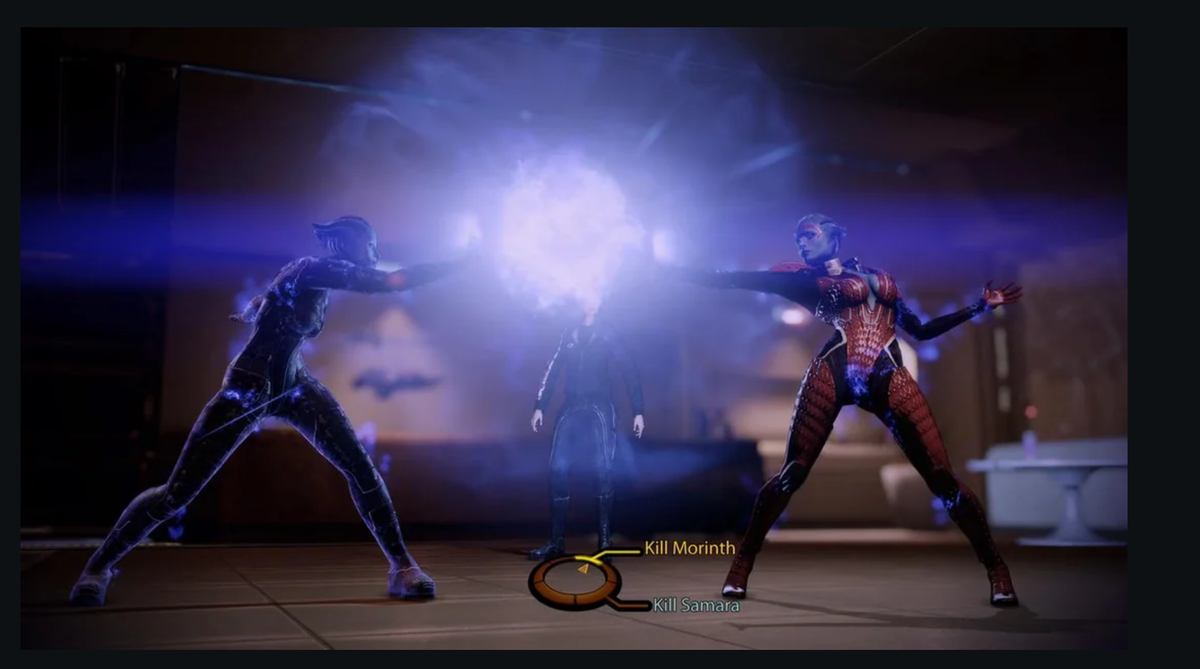
A classic example of an effective choice is the moment in Mass Effect 2 where you choose whether to ally yourself with Samara the alien MILF paladin or her evil succubus daughter. There’s no compelling reason to team up with Samara’s evil daughter--your outcomes in ME2 and 3 will be notably worse--but you can and you will then experience the results. This choice gives you the opportunity to Play with different versions of the archetype Samara fills in your party and different outcomes to her story, even if the choice’s ultimate message of cleavage-y but celibate good being better than skanky partygirl evil is pretty eyeroll-inducing.
Expressive choices affect how you the player experience or feel toward the game without actually changing the outcomes of your encounters or playthrough. If you give yourself a mustache during character creation, it rarely comes up in gameplay but it may change how you perceive your silly-looking character. Similarly, if you choose a line of conciliatory dialogue over a line of aggressive dialogue, but the NPC you’re talking to responds the same way regardless, you made an expressive rather than effective dialogue choice. It gave you control over the performance of your character in the same way every Shakespearean actor delivers their monologue in unique fashion even though Hamlet’s gonna die everrrrry time. There is true artistic value in that, but it is different than the value delivered by a change to the narrative.
Expressive choices can feel exquisitely, beautifully, profoundly important to you-the-player, and it’s usually fine if they make little direct change to the game’s mechanics or narrative, so long as the change they make in your head feels right.
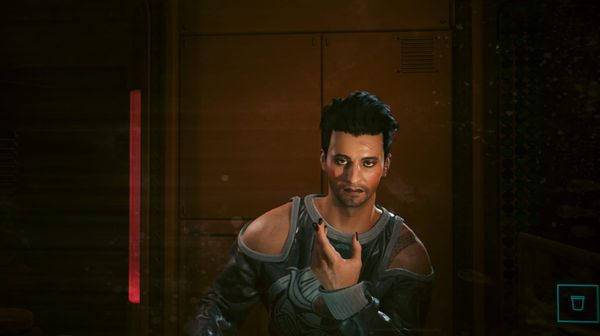
A great example of a compelling expressive choice is your safeword in the dollhouse brothel scene of Cyberpunk 2077. You choose from two or three thematically weighty safewords which all evoke some aspect of your history or Johnny Silverhand’s. This choice means absolutely nothing in terms of concrete outcomes for the game, but it makes room for you to freight it with all kinds of meaning. You’re choosing how you occupy and shade the Role of V, 2077’s protagonist, and so the choice feels very satisfying and enriches the scene much more than giving you one predetermined safeword would.
Most CRPGs have both kinds of choices sprinkled throughout. Some choices are both at once. In games with sex-determined love interests, choosing your player character’s sex is effective, in that it determines the availability of your romance options, and expressive, in that it changes your experience of and relationship to your own character.
In the ancient days, long before I could operate a computational device, almost every choice in the average CRPG was effective and there were few expressive choices. Fallout: A Post Nuclear Role Playing Game has limited dialogue and little for you to design about your character beyond leveling, but you sure can blow everybody up if you feel like it and the game will happily narrate your bad choices back to you in the ending slideshow. In a time when fitting lots of cutscenes and sound effects and sprites onto a humble compact disc was beyond the power of the gods, Fallout expressed what it could as an isometric game with limited conversations and lots of opportunities to wreak havoc, consequences conveyed by simple visuals supplemented with text and, like, five evocative musical tracks.
Games in the Fallout tradition persist to this day, now accommodating lots more expressive choices along with the effective ones while maintaining their essentially game-ish texture. These are the Playing-oriented role-playing games: their carefully-limited visual detail and often only partial voice-acting allow them to offer a plethora of interesting outcomes expressed mainly through that still-cheapest trio: text, traditional 2D art, and player imagination. They zhuzh up the basic forms of Fallout and its ilk with higher-quality graphics, better sound, and somewhat more accessible mechanics, but they hold to the premise that a role-playing game is essentially a machine for putting characters into scenarios and need not look or feel like other media.
The biggest games in the CRPG space are now heavily Role-oriented, however. They’ve crept laterally towards scripted linear experiences like Call of Duty campaigns and straight-up movies, and in doing so loaded themselves with laborious hi-def cutscenes as if they dream of being the adult-targeted animated movies we don’t make in America for some reason. All these visual flourishes, these adherences to the rules of other media, these remove the opportunities for effective choice which were so prolific in the primitive dimensions of Fallout. Fights and choices are a sort of occasional minigame, the outcomes of which are irrelevant to the outcome of the game’s narrative, which you will probably pick from a list of three to five options some time in the final forty-five minutes. Your character will have a voice, an obtrusive and emotive voice. The Role in which the player’s been cast becomes more important than Playing the game. It’s this form with which I’m struggling to engage, this turn in design norms which is putting me off the CRPG form. I sometimes long for tedium while playing these big-budget Role-heavy games. I wish for the opportunity to fiddle with character builds and equipment loadouts that actually change how I’m playing the game moment-to-moment. I’m not sure being a glorified immersive movie actor is what I want from a computer game. LARPs already exist and they allow one to make new friends in real life, not more fake friends who are actually the intellectual property of a Blackrock subsidiary.
I jest, of course. I deeply love all my fake friends who belong to Blackrock.
CRPGs started as one thing: a way to play tabletop games by yourself. Now many of them have become another thing: a self-insert science fiction/fantasy Netflix original series. Meanwhile the CRPGs that still let you play tabletop games by yourself (or sometimes with a friend who’s far away!) run around in the dark cabinets of Steam like cockroaches. How did we get here? Next installment we’ll consider the crisis which I believe to have hardened the Role vs. Playing split into a chasm nigh-impassable.
We were never going to get out of here alive without discussing the game that Role vs. Playing tensions destroyed: Mass Effect 3.